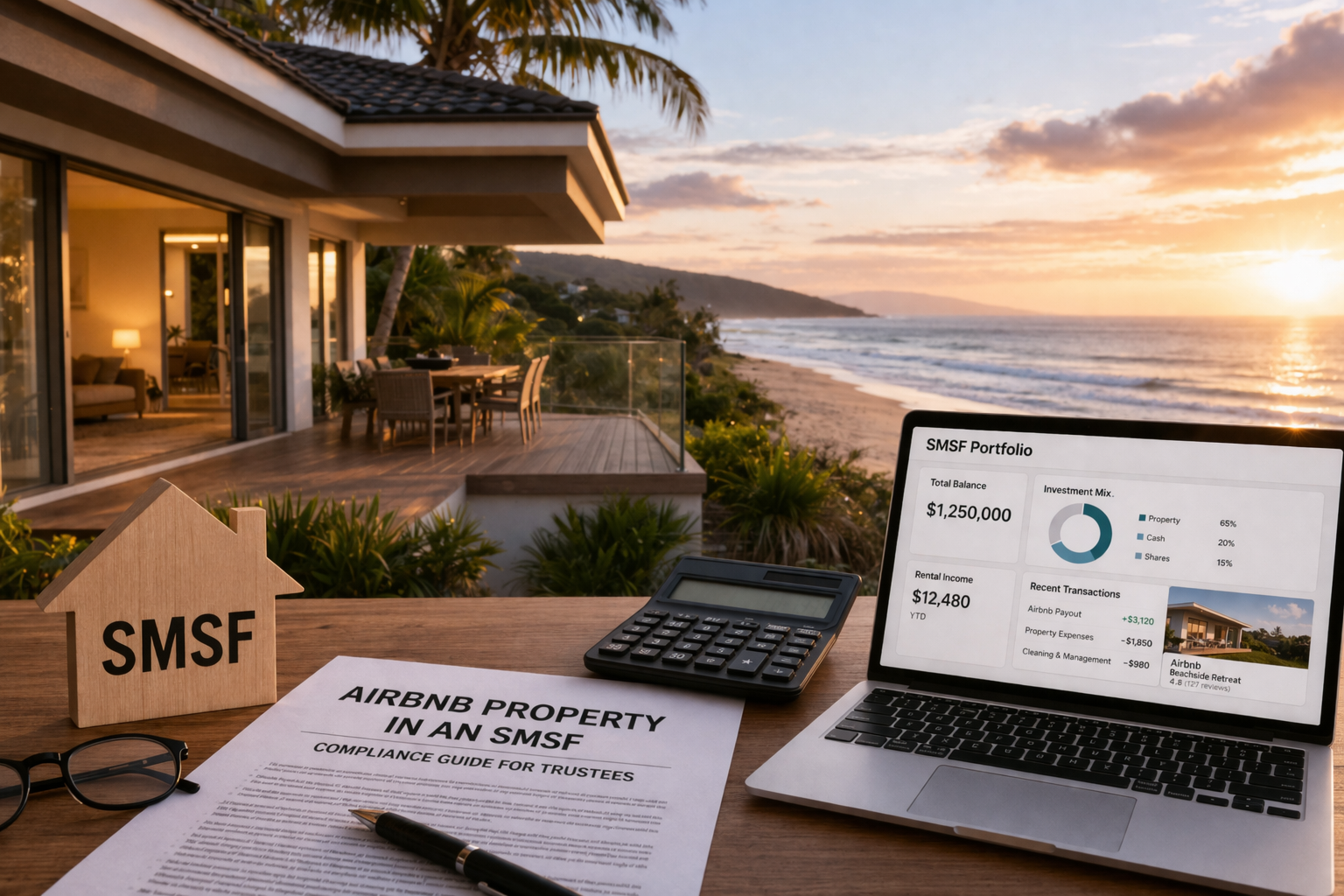
Holding an Airbnb Property in an SMSF: Compliance Guide for Trustees
Using a Self-Managed Super Fund (SMSF) to hold short-term rental property — such as Airbnb accommodation — is legally permissible in Australia.
However, trustees must comply strictly with the Superannuation Industry (Supervision) Act 1993 (SIS Act), related-party rules, arm’s length requirements, and audit standards.
Airbnb properties inside superannuation are frequently misunderstood. The compliance risk does not arise from short-term letting itself — it arises from personal use, related-party access, documentation failures, and Non-Arm’s Length Income (NALI) exposure.
This guide outlines: • Whether Airbnb is allowed in an SMSF • Sole purpose test implications • Related-party restrictions • Arm’s length and NALI risks • Borrowing (LRBA) considerations • GST issues • Audit documentation requirements • Practical compliance safeguards
1. Is Airbnb Allowed in an SMSF?
Yes. An SMSF may acquire residential property and lease it on a short-term basis (e.g., Airbnb) provided: • The property is held strictly for investment • It is rented only to unrelated parties • All dealings are conducted at arm’s length • There is no private use by members or related parties
There is no prohibition on short-term letting under superannuation law. The compliance risk lies in how the property is used and managed.
2. The Sole Purpose Test – No Personal Use
Section 62 of the SIS Act requires the fund to be maintained solely for retirement benefits. This means: • Members cannot stay in the property • Relatives cannot stay in the property • No “mates’ rates” bookings • No personal use during vacant periods • No discounted bookings for related parties
Even a single night of private use may constitute a breach. This rule applies regardless of whether market rent is paid. Residential property owned by an SMSF cannot be leased to related parties under any circumstances.
3. Arm’s Length Requirements and NALI Risk
All transactions must be commercial.
3.1 Discounted Services
If: • A related party cleans the property below market rates • A relative manages bookings at a discount • Repairs are completed below commercial rates
The income derived from the property may be taxed at 45% under the Non-Arm’s Length Income (NALI) provisions.
3.2 Free Labour
Members cannot provide unpaid labour to enhance the asset. Even well-intentioned assistance may create compliance exposure.
3.3 Below-Market Management Fees
If a related property manager charges below commercial rates, NALI may apply. All services must reflect commercial pricing.
4. Borrowing to Acquire an Airbnb Property (LRBA)
If the SMSF borrows to acquire the property: • A Limited Recourse Borrowing Arrangement (LRBA) must be properly structured • A holding (bare) trust must be established before contract exchange • The property must be a single acquirable asset • Borrowed funds cannot be used for improvements
Renovation restrictions under LRBA must be carefully managed.
Additionally, lenders may: • Restrict short-term letting • Require disclosure of Airbnb usage • Apply stricter lending criteria
Trustees must review loan covenants before operating short-term accommodation.
5. Investment Strategy Requirements
Before acquiring an Airbnb property, trustees must update the investment strategy to consider: • Liquidity risk • Concentration risk • Vacancy risk • Seasonal income fluctuations • Insurance requirements • Local council restrictions
Short-term accommodation income is often volatile. Auditors expect documented evidence that trustees considered these risks before acquisition.
6. GST Considerations
Residential rent is generally input-taxed and does not attract GST.
However, short-term accommodation may be treated differently depending on: • Scale of operation • Services provided • Whether the activity resembles a commercial residential premises
Most standard Airbnb properties will not trigger GST registration. However, trustees should assess: • Annual turnover • Nature of services provided • Whether the activity resembles a hotel operation
Incorrect GST treatment may create compliance issues.
7. Local Council and Regulatory Compliance
Trustees must ensure: • Local zoning permits short-term letting • Strata by-laws allow Airbnb • Appropriate insurance is in place • Building and fire compliance standards are met
Non-compliance with local law may impact valuation and audit risk.
8. Record-Keeping and Audit Documentation
SMSF auditors will expect evidence of: • Title ownership • Lease or platform agreements • Booking records • Rental income statements • Market rental rates • Expense invoices • Arm’s length service contracts • No personal use declarations
Trustees should maintain: • Airbnb platform statements • Bank reconciliation records • Independent market rent evidence • Minutes approving acquisition and strategy update
Poor documentation is a common audit issue.
9. Liquidity and Cash Flow Risk
Airbnb properties typically involve: • Higher turnover • Higher maintenance costs • Cleaning and management expenses • Variable income
Trustees must ensure: • Adequate liquidity buffer • Ability to meet loan repayments (if applicable) • Ability to pay tax, audit and compliance costs
Concentration of fund assets in a single volatile property may be inappropriate for some SMSFs.
10. Common Compliance Failures
Observed issues include: • Trustees staying in the property during vacant periods • Relatives booking at discounted rates • Informal cleaning arrangements with family • No documented investment strategy update • Understated rental income • No independent market valuation
These may result in: • Auditor contravention reports • Administrative penalties imposed personally • NALI taxation at 45% • Regulatory scrutiny
11. Conservative Compliance Position
From a compliance perspective:
Airbnb property in an SMSF is permissible — but only where: • There is absolutely no personal use • All dealings are commercial • Documentation is comprehensive • Liquidity is properly managed • LRBA restrictions are respected
If the motivation includes lifestyle use, the strategy is inappropriate for superannuation.
Conclusion
An SMSF may legally hold and operate an Airbnb property, provided it remains a genuine arm’s length investment and strictly complies with superannuation law.
The key compliance pillars are: • No related-party use • Arm’s length services and pricing • Proper LRBA structuring (if borrowing) • Updated investment strategy • Comprehensive documentation
Short-term rental inside superannuation is not inherently problematic — but it is administratively demanding and compliance-sensitive.
Trustees should obtain specialist SMSF advice before acquiring or converting a property to Airbnb use to ensure regulatory compliance and protect the fund’s status.