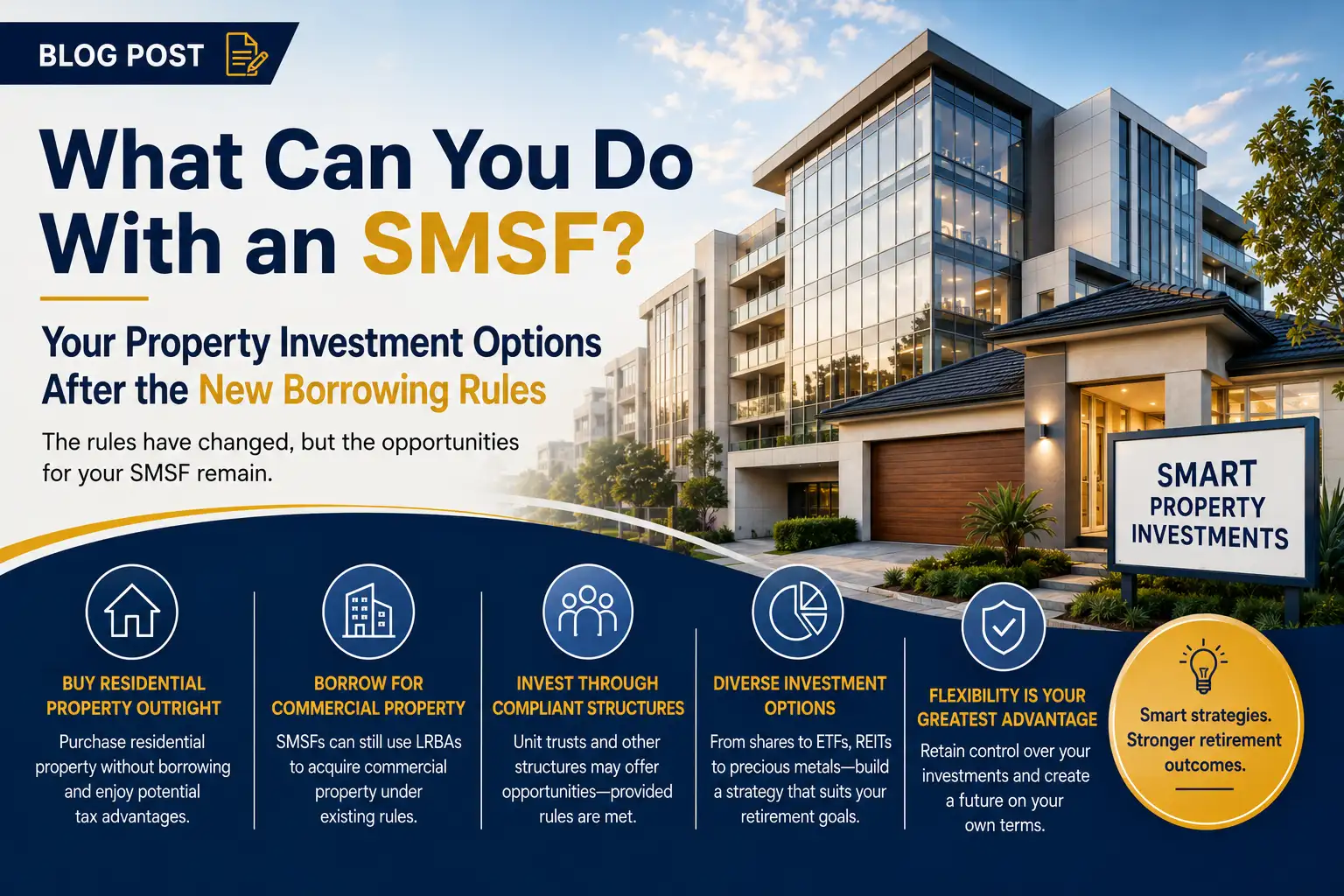
What Can You Do With an SMSF? Your Property Investment Options After the New Borrowing Rules
Self-Managed Super Funds (SMSFs) remain one of the most flexible and tax-effective ways for Australians to invest for retirement. While recent changes announced by the Federal Labor Government have altered how SMSFs can invest in residential property, there are still numerous opportunities available for trustees who understand the rules.
If you’re considering using your super to build wealth, it’s important to understand not only what has changed—but also what remains possible.
The Recent Changes to SMSF Borrowing
The Federal Labor Government has legislated changes that will prohibit new Limited Recourse Borrowing Arrangements (LRBAs) being used by SMSFs to acquire residential property. Existing arrangements are grandfathered, but new residential property purchases using an LRBA will no longer be permitted after the commencement date. SMSFs can still borrow to acquire commercial property under the existing LRBA rules.
While this represents a significant change for residential property investors, it does not mean SMSFs can no longer invest in residential real estate.
Buying Residential Property Without Borrowing
One of the simplest alternatives is purchasing residential property outright.
If your SMSF has sufficient cash or investments that can be realised, the fund can still purchase residential investment property without any borrowing.
Many established SMSFs have accumulated enough assets over time to purchase apartments, townhouses or houses outright, allowing members to benefit from:
· Rental income taxed at a maximum of 15% while the fund is in accumulation phase.
· Potential capital gains concessions if the property is held for more than 12 months.
· Tax-free rental income and capital gains once the property supports retirement phase pensions (subject to the fund’s transfer balance cap and applicable superannuation rules).
Although buying without finance requires more capital upfront, it also removes interest costs and lending restrictions.
Can an SMSF Still Borrow?
Yes.
The new legislation targets residential property acquired through an LRBA.
Borrowing remains available for many commercial property investments, making SMSFs particularly attractive for business owners wanting to purchase their own business premises.
For example, an SMSF can still acquire:
· Offices
· Warehouses
· Industrial properties
· Medical suites
· Retail shops
· Commercial units
using a compliant Limited Recourse Borrowing Arrangement.
This allows many small business owners to pay rent to their own super fund rather than a third-party landlord.
Using a Unit Trust Structure
Depending on the circumstances, some investors may still consider investing through a unit trust.
A properly structured unit trust can allow multiple investors—including an SMSF—to jointly invest in property. However, the structure must comply with the superannuation rules and the Superannuation Industry (Supervision) Act 1993.
Where borrowing is involved, the structure becomes considerably more complex and specialist legal and accounting advice is essential.
There are strict rules governing:
· Related party investments
· In-house assets
· Financial assistance
· Arm’s length dealings
· The sole purpose test
If incorrectly established, a unit trust can result in compliance breaches and significant tax consequences.
For this reason, trustees should always obtain professional advice before establishing or investing through a unit trust.
Other Investments an SMSF Can Make
Property is only one part of an SMSF’s investment strategy.
SMSFs can also invest in:
· Australian shares
· International shares
· Exchange Traded Funds (ETFs)
· Managed funds
· Fixed interest investments
· Cash and term deposits
· Listed property trusts (A-REITs)
· Commercial property
· Precious metals
· Cryptocurrency (where permitted under the investment strategy and trust deed)
Every investment must satisfy the fund’s documented investment strategy and comply with the sole purpose test—providing retirement benefits for members.
Flexibility Remains the Biggest Advantage
Despite the changes to residential property borrowing, SMSFs continue to offer Australians a level of investment control that traditional superannuation funds simply cannot match.
Trustees retain the ability to:
· Choose exactly where their retirement savings are invested.
· Purchase residential property outright.
· Borrow for eligible commercial property.
· Invest alongside others through compliant structures where appropriate.
· Tailor an investment strategy to their personal retirement goals.
For many Australians, the flexibility and control provided by an SMSF remain its greatest strengths.
Thinking About Setting Up an SMSF?
The recent changes have altered one investment pathway—but they certainly have not removed the opportunities available through an SMSF.
Whether you’re looking to purchase commercial property, buy residential property outright, or simply gain greater control over your retirement savings, professional advice is more important than ever.
At SMSF Wizard, we help Australians establish compliant SMSFs, navigate complex borrowing rules, and develop strategies that align with both current legislation and long-term retirement objectives.
If you’re considering setting up an SMSF or would like to understand your property investment options under the new rules, contact SMSF Wizard today.